
AI-Powered Localization in Publishing: Scaling Multilingual Content Without Losing Accuracy and Brand Voice
A practical guide to AI-powered localization, combining structured content, terminology and human review to scale multilingual publishing with confidence.
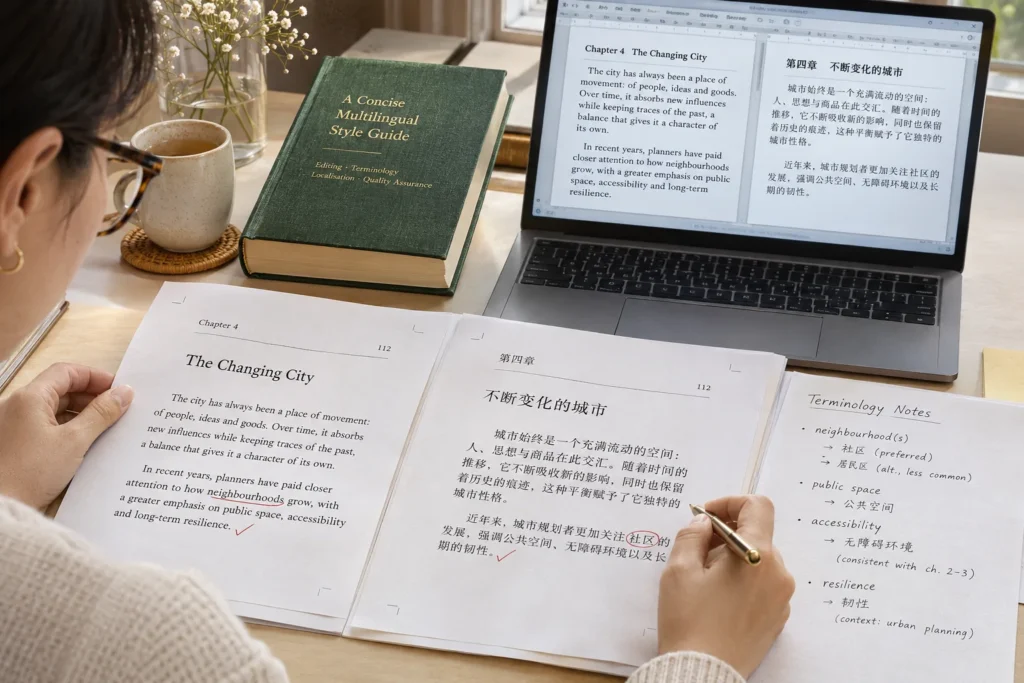
AI-powered localization is helping publishers reach global audiences beyond an English-language PDF. Readers expect content that feels natural in their language, works on their devices and respects local terminology, formats and cultural context. This applies to academic and professional publishers, training providers, technical documentation teams and organisations that publish customer-facing knowledge at scale.
Artificial intelligence can change the cost and turnaround time of localization, depending on language, content type and review requirements. It can accelerate translation, identify terminology, prepare content for multilingual workflows and flag inconsistencies across large collections. But speed alone is not quality. Publishing content carries meaning, authority and often legal or safety implications. If translation changes a technical instruction, misrepresents an author’s argument or makes a claim sound stronger than intended, the cost of correction can outweigh the time saved.
The practical opportunity is to combine AI automation with structured content, trained language reviewers and reliable workflow controls. Done well, AI-powered localization helps publishers scale multilingual content without losing accuracy, brand voice or reader trust.
Localization is more than translation
Translation converts words from one language to another. Localization adapts a complete content experience for a target audience. It considers terminology, spelling variants, date and number formats, units, currencies, examples, user-interface text, images, links, legal statements and reading direction.
For example, a training guide translated from English to Arabic may require right-to-left layout, different text expansion rules and revised screenshots. A healthcare article may need local medical terminology and regulatory language. A textbook may need examples that work for a regional curriculum. A simple word-for-word translation cannot reliably handle these requirements.
Internationalization is the foundation that makes localization possible. It means designing the source content, publishing platform and workflow so that multiple languages can be supported from the beginning. W3C guidance emphasises that language information affects processing such as text-to-speech, styling, translation, search and information retrieval. Language is therefore not a label to add at the end of production; it is part of the content data model.
Why publishers are turning to AI-powered localization
Publishing teams face pressure to produce more content in more languages while controlling cost and turnaround time. Backlists, documentation libraries, learning modules and journal information pages can contain thousands of pages. Traditional workflows that begin from unstructured files and depend on manual copy-and-paste are slow and difficult to audit.
Depending on the system and workflow, AI can assist with identifying content types, extracting translatable text, suggesting translations, checking terminology and detecting inconsistencies. Review rules can route uncertain or high-impact segments to human reviewers. These capabilities are especially useful for high-volume, repetitive content, but the final published version still needs a clear owner and review process.
Start with structured, localization-ready source content
The quality of AI localization depends heavily on the source. Content stored as clean XML, HTML, JATS, DITA or well-structured CMS records is easier to segment, translate, validate and republish. It separates content from presentation, allowing the same approved text to feed web pages, EPUBs, PDFs, apps and learning platforms.
Unstructured source files create avoidable risk. A translator or model may not know whether a phrase is a heading, a button label, a figure caption or an instruction that must remain unchanged. It may translate variable names, product names or markup accidentally. Structured content protects those elements and gives translation tools context.
Before introducing AI, publishers should define what is translatable and what is not. Common non-translatable elements include product names, code, identifiers, formulas, URLs and controlled metadata values. Approved legal clauses should follow the organisation’s legal review and translation policy rather than being changed automatically. A good content model also identifies the language of the source and each localized version. Crossref recommends providing language metadata wherever possible for multilingual content, because language and translation information affect discovery and citation display.
Build a terminology and style foundation
The quickest way to damage quality at scale is to translate without an approved terminology base. A glossary should include preferred terms, forbidden alternatives, abbreviations, product names, subject-specific vocabulary and context notes. For a technical publisher, it may distinguish “configure,” “install” and “deploy.” For an academic publisher, it may define how discipline names, institution names and citation terms should appear in each language.
Style guidance matters as much as terminology. It should explain tone, formality, spelling convention, punctuation, inclusive language, units, date formats, capitalization and how to handle quotations. This guidance gives both human reviewers and AI tools a common standard.
Translation memory is also valuable. It stores previously approved source-target pairs so recurring phrases can be reused consistently. AI can propose new wording, while translation memory provides approved repeated content that should be checked for context and currency before reuse. This reduces cost and avoids the frustrating experience of seeing the same navigation label translated differently across pages.
Use AI as a controlled assistant
An effective AI-powered localization workflow does not send a complete manuscript to a public tool and accept the output unchanged. It uses secure, approved systems and clear checkpoints.
First, prepare the content. Remove duplicate material, validate the source structure, protect non-translatable segments and attach context such as the target audience, publication type and relevant glossary. A software help article and a marketing landing page may need very different tone instructions even when they describe the same product.
Next, use AI translation to produce a draft or to assist human translators. The system should receive the approved terminology and style rules, not just the text. It should flag uncertain segments rather than inventing an answer. A confidence signal, where available and validated, can help prioritise review, but it should not be the only quality measure; models can be confident and wrong.
Then, apply localization quality assurance with automated checks and human review. Look for missing translations, unchanged source text, number and unit mismatches, broken tags, altered URLs, inconsistent names and invalid language codes. Finally, use human linguistic review for high-impact, low-confidence or culturally sensitive content. Reviewers should compare the localized version with the source, check terminology and ensure the content reads naturally for the intended audience.
Protect brand voice and technical accuracy
Brand voice is the consistent way a publisher explains ideas, gives instructions and speaks to readers. AI can produce fluent text that does not sound like the publisher, or make a technical statement less precise in an effort to sound natural. Use short language-specific examples of approved content to improve prompts, reviewer training and quality checks.
Technical accuracy needs a separate safeguard. Terms in aviation, medicine, finance, law and engineering often cannot be judged by general fluency. Content owners or subject-matter experts should review critical terminology and safety-related instructions. In many cases, the best process is two-step review: a language specialist checks readability and a domain specialist verifies meaning.
Localize metadata, not only the body text
A translated article is difficult to find if its title, abstract, keywords, alt text and landing-page metadata remain in the source language. Publishers should localize the discovery layer alongside the content itself.
This includes language codes, translated titles and abstracts, keywords, descriptions, image alt text, accessibility labels and page metadata. Each translation should retain a clear relationship with the original record, including version, identifier, rights and publication date. Crossref advises publishers not to place multiple translated titles in one title field because it harms discoverability and citation formatting. Instead, maintain distinct, structured multilingual metadata where supported by the record type.
This approach supports readers and machines alike. Search engines can return the right language version, platforms can apply language-specific filters and assistive technologies can select appropriate pronunciation rules.
Measure quality, cost and reader value
AI-powered localization should be managed as a publishing process, not a one-time experiment. Measure turnaround time, cost per word or page, translation-memory reuse, reviewer changes, quality defects and reader feedback. Compare these results by language, content type and subject area.
The most useful measure is not how many words the model processed. It is whether readers can understand and act on the content without confusion. Monitor support requests, completion rates for learning modules, search behaviour, bounce rates and feedback from regional teams. If a particular language has high correction rates or lower engagement, investigate the source content, terminology base and review process.
A sensible starting point
Choose one content set with clear value and manageable risk: a product guide, a collection of learning modules, a set of journal author instructions or a high-demand backlist. Establish the terminology, source structure, security requirements and review roles before producing the first translation.
Run a pilot across two or three languages with different writing systems or levels of complexity. Review the output closely, document what worked and use those findings to improve the workflow. Only then expand to more content and markets.
Final takeaway
AI can make multilingual publishing faster, but it does not remove the need for editorial judgement. Publishers that treat localization as a structured, controlled and measurable process can use AI to reduce repetitive work while preserving the accuracy and voice that readers trust.
The winning model is not AI alone or manual work alone. It is a well-designed workflow in which structured content, terminology, automation and human expertise reinforce one another.